Faregotten
Faregotten by Flighty: from flight delay to compensation paid
A product teardown of Flighty, and a standalone business built on the moment Flighty stops: telling delayed travelers what they’re owed and helping them actually get paid.
Product Manager case study2026
Outcomes
- interviews + survey responses
- 5 + 13
- Plus 100+ public reviews
- took no action or gave up
- 22%
- Of affected travelers surveyed
- would pay a success fee
- 85%
- Most capped it at 10%
- pricing tiers
- 3
- Free check, $10 DIY, 20% full handling
- year-one revenue
- ~€0.36M
- Bottom-up, ~16,000 detected delays
- revenue if fully captured
- ~€0.9B
- Top-down, EU delay wedge
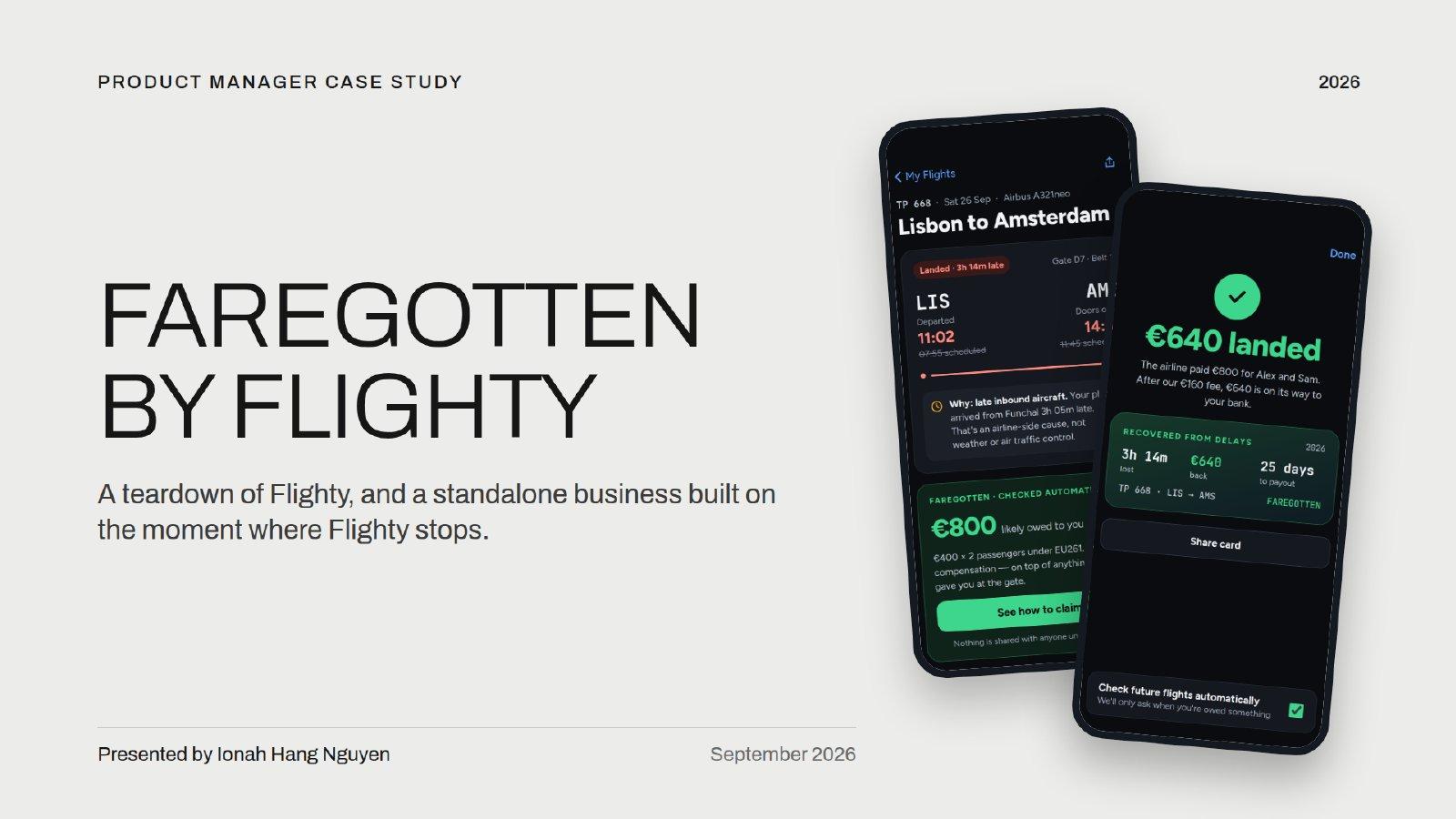
The landing moment
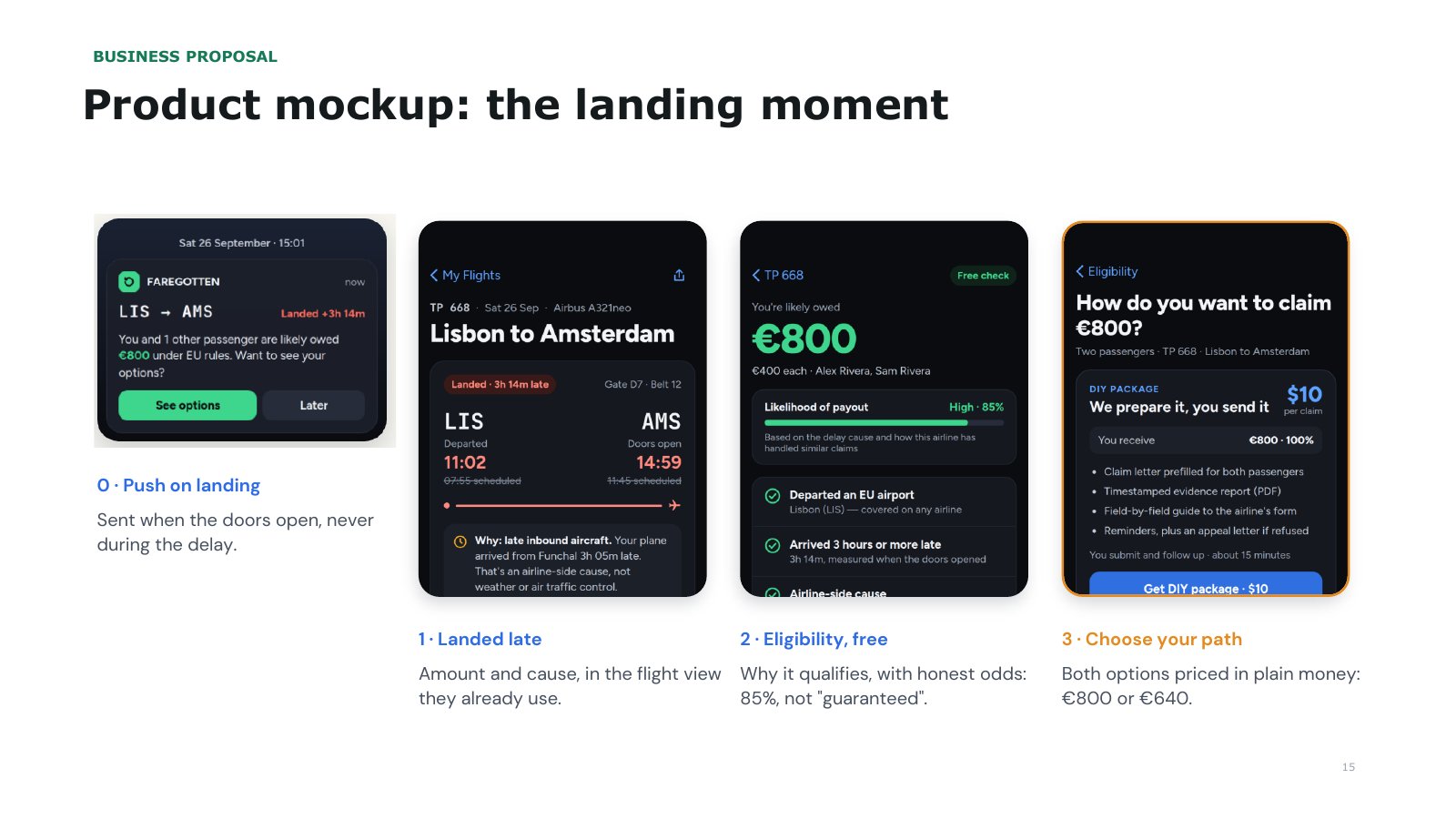
Context
Flighty is an iOS flight-tracking app for frequent and high-stakes travelers. It combines real-time status, delay predictions, inbound-aircraft tracking and proactive alerts (4.8★ on the App Store from 154K ratings, 65+ Pro alerts, 25-hour inbound-aircraft tracking). I tore down the product to understand why travelers trust it, then proposed Faregotten: a new business built on the job Flighty leaves unfinished.
Challenge
Flighty sells certainty: it alerts travelers before the airline does and explains why. But once the plane lands, the traveler is on their own. They still have to work out whether they’re owed money, file the claim and chase the airline. Most never do: AirHelp estimates 38M passengers worldwide were entitled to compensation in 2024 and about 60% didn’t try to claim, and the FT puts unclaimed compensation in Europe at €3.2B. Under EU261 that’s €250–€600 per passenger, left on the table.
Approach & key decisions
Tear down the trust loop first
Step 1I mapped Flighty’s core journey (add the flight, monitor quietly, alert and explain, help the traveler act) and the loop it creates: every trip is another chance to prove an early, accurate alert. Supporting loops like Flighty Friends and Passport add coordination and memory. The behavior it creates is delegation: travelers stop checking several sources and let Flighty watch.
Find where the job is unfinished
Step 2After disruption the traveler’s questions run: what happened, should I rebook, am I entitled to money, how do I submit, will the airline respond, when will I be paid. Flighty answers the first two. The recovery burden, from eligibility to payout, still sits with the traveler. That gap became the opportunity.
Ground it in research
Step 3I read 100+ public reviews of AirHelp, AirAdvisor and Skycop, plus Reddit threads and BBB complaints, then ran 5 customer interviews and a 13-response survey. 22% of affected travelers took no action or abandoned the claim. The biggest frictions were understanding what they could claim (75%), getting the airline to respond (63%) and knowing whether they were eligible (38%).
Segment by claim behavior and pick one to start
Step 4Three segments emerged: unaware travelers who need automatic detection, time-poor delegators who want complete handling for a clear fee, and rejected DIY claimants who need evidence and escalation. I prioritized time-poor travelers as the first paid segment, and designed the journey to follow their emotions: monitor during the disruption, offer the claim only after final arrival.
Design one entry point, two paths
Step 5Flighty users already have the trip saved; others upload a confirmation or boarding pass. Both converge on a free eligibility check, then choose a path: a prefilled DIY claim package they submit themselves, or complete handling where Faregotten submits, follows up and tracks payout. DIY users can switch to managed handling if the airline rejects or ignores them.
Price from willingness to pay
Step 669% of respondents would pay something for a DIY package and 85% would pay a success fee, mostly capped at 10%. That set a three-tier model: free eligibility assessment to build trust and qualify demand, $10 per DIY claim, and a 20% no-win-no-fee success fee for managed claims. That’s well under incumbents like AirHelp at 35%, possible because Flighty users arrive at near-zero acquisition cost.
Start with the strongest wedge, and gate the roadmap
Step 7I scored six candidate wedges on whether Flighty can detect the trigger, the money is meaningful, the traveler must act, and it can be tested by hand. EU/UK arrival delays of 3+ hours won on every count. The roadmap moves from demand and trust validation to a 50-case concierge pilot, then productizing and scaling one axis at a time, each stage with its own gate. The north star is successful recovery rate: the share of eligible claimants who get paid.
Work sample
Product manager case study deck
The deck I built for this case study: a teardown of Flighty, the research behind the opportunity, the product and business model for Faregotten, and how to roll it out.
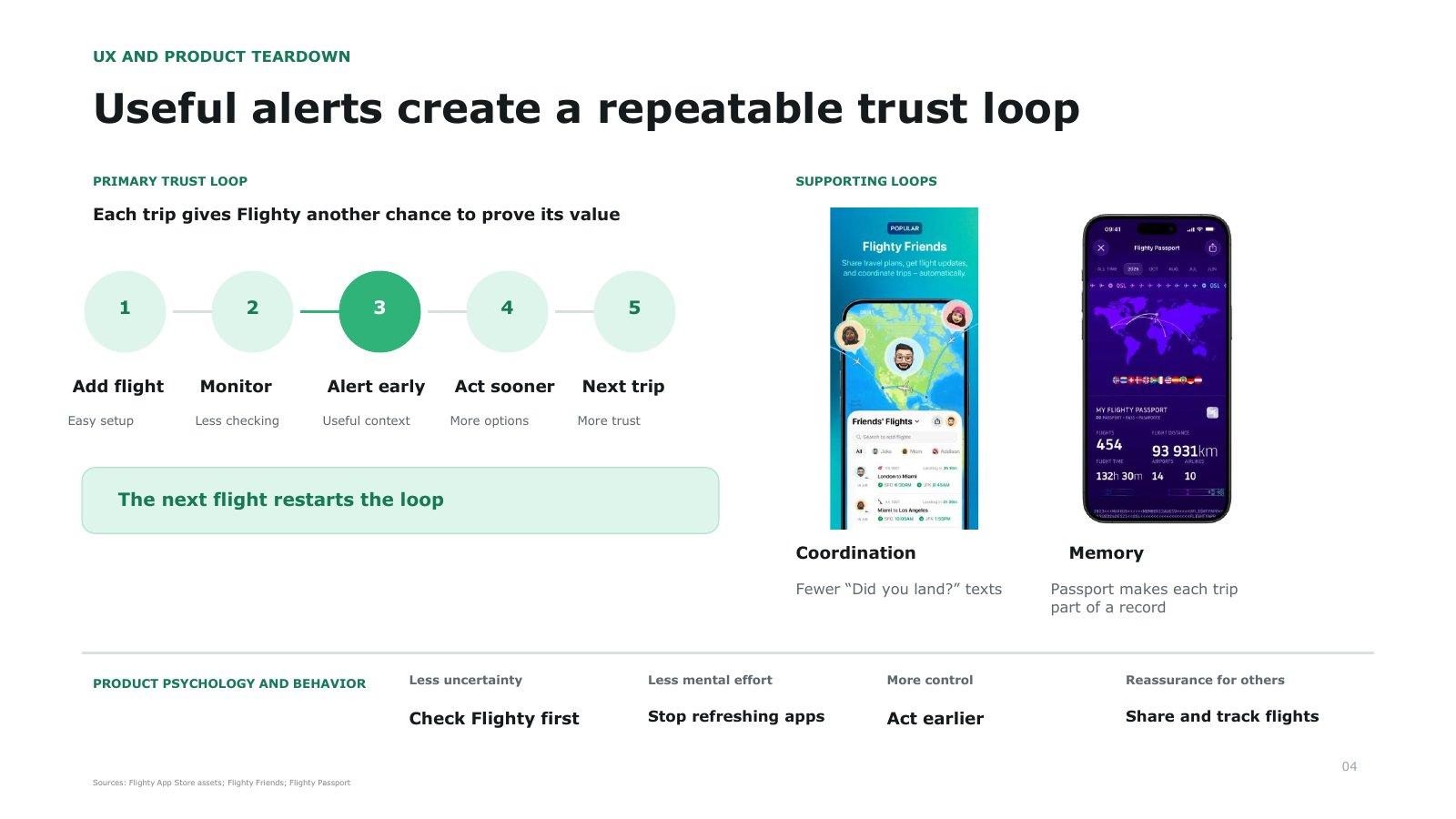
Teardown: Flighty’s trust loop 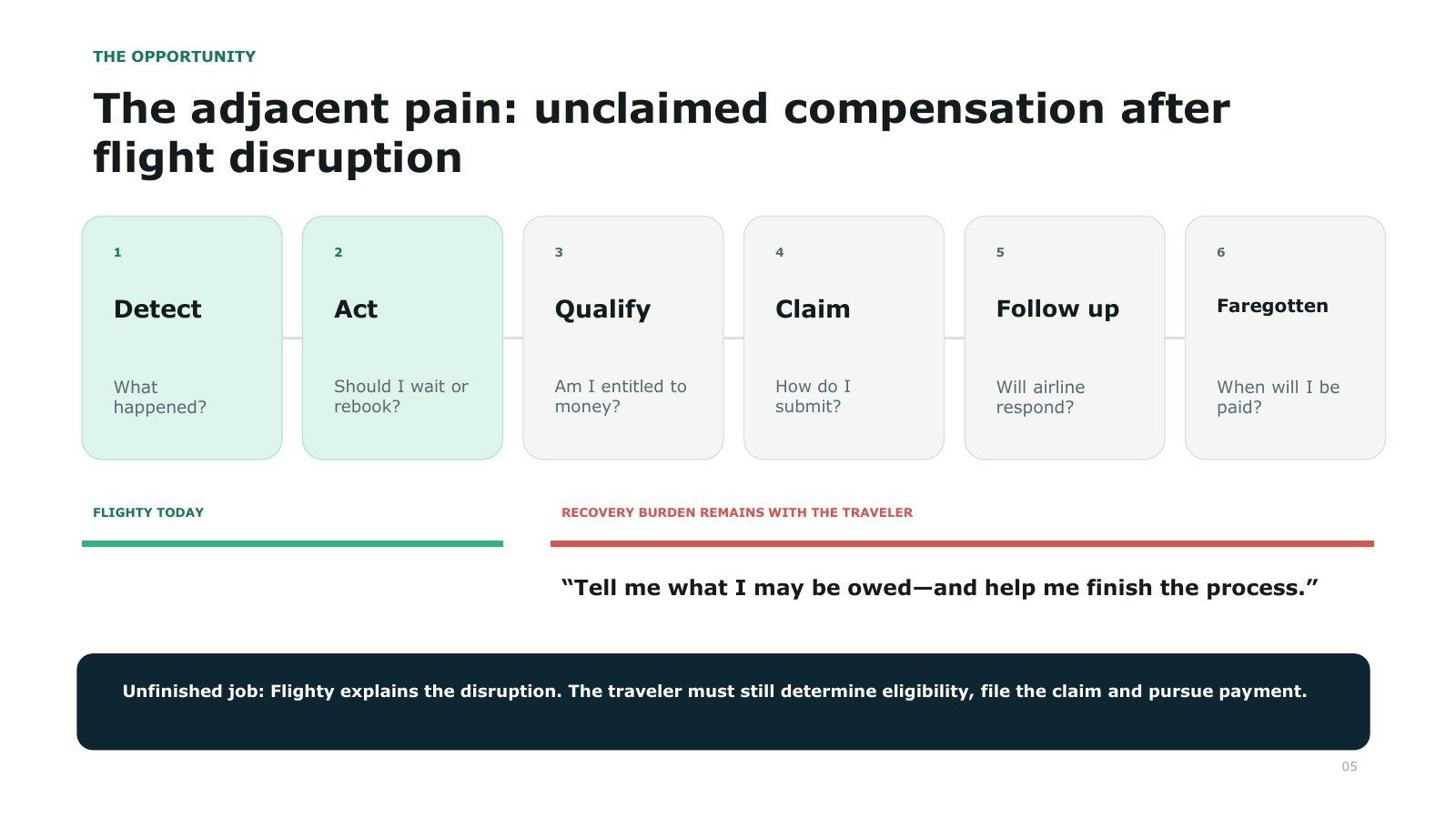
The unfinished job after disruption 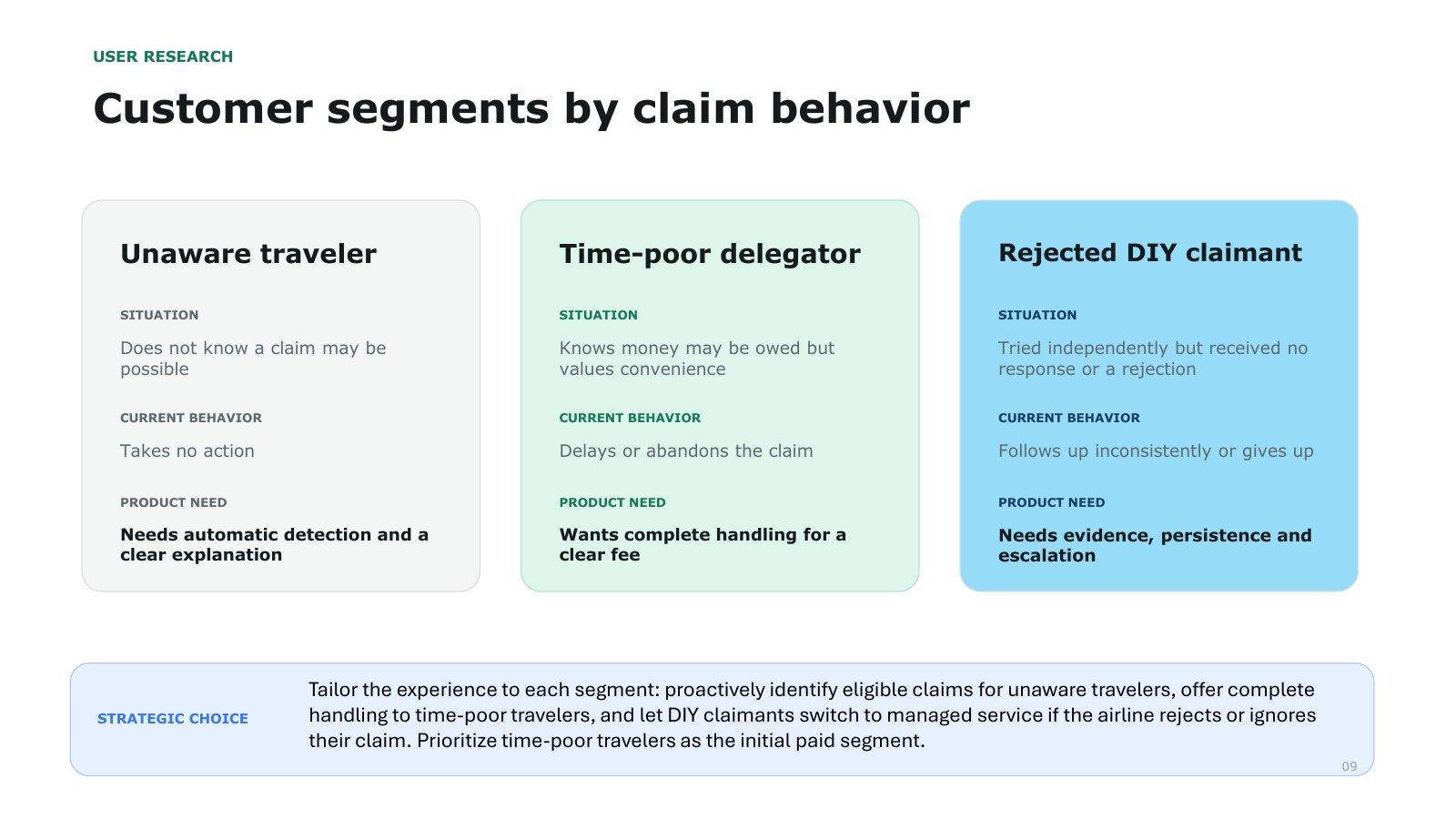
Three segments by claim behavior 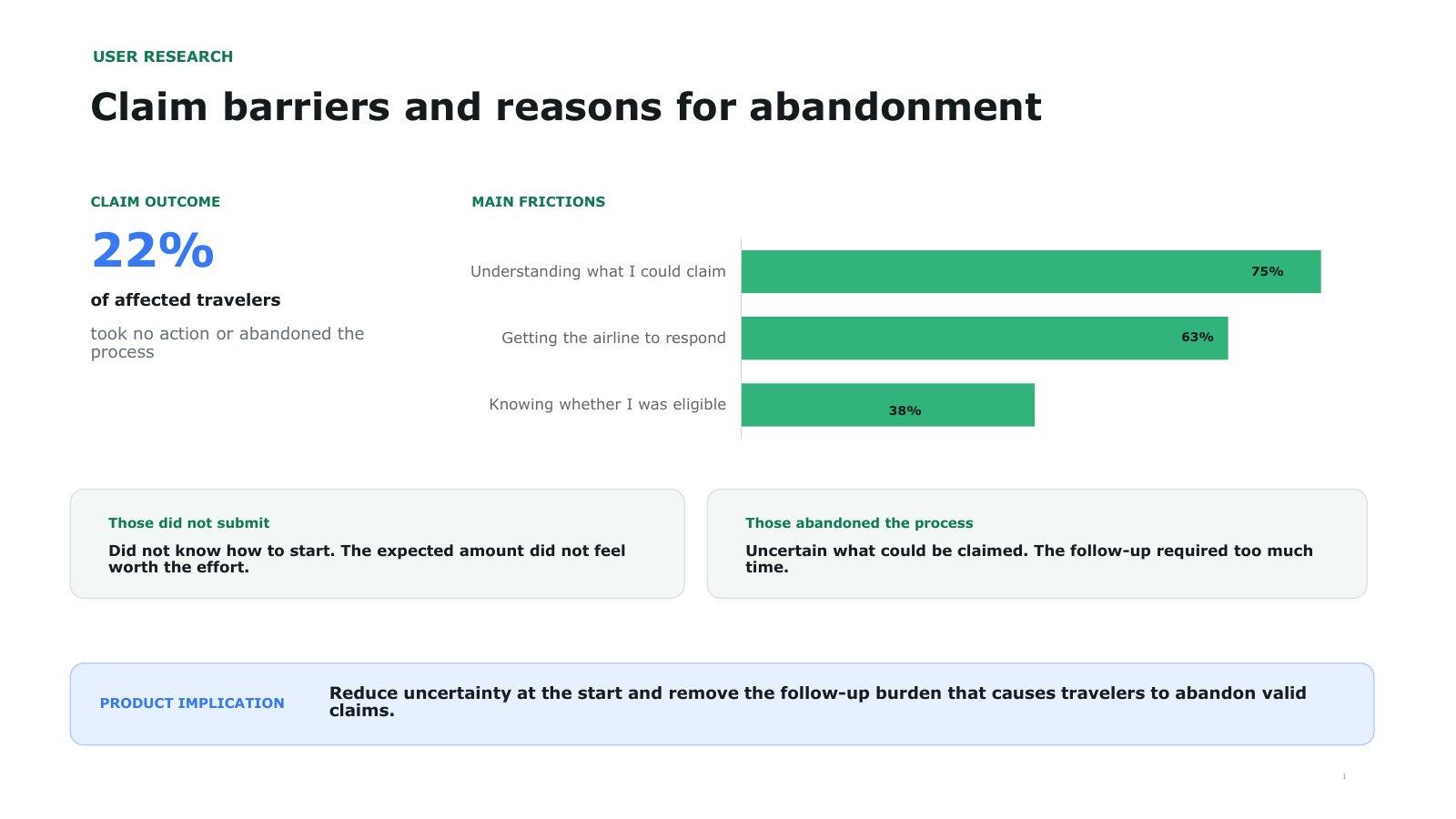
Why travelers abandon valid claims 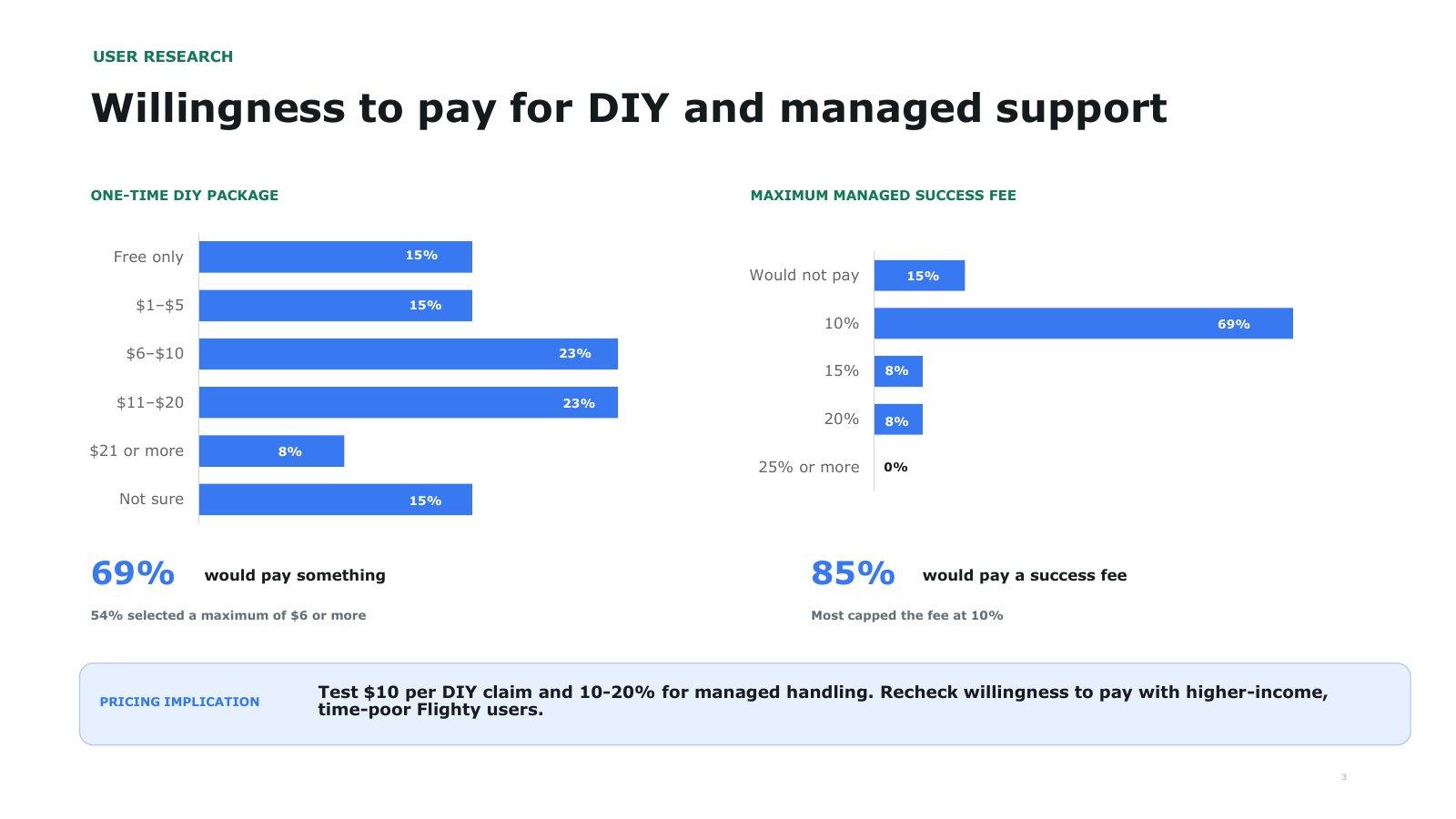
Willingness to pay, DIY and managed 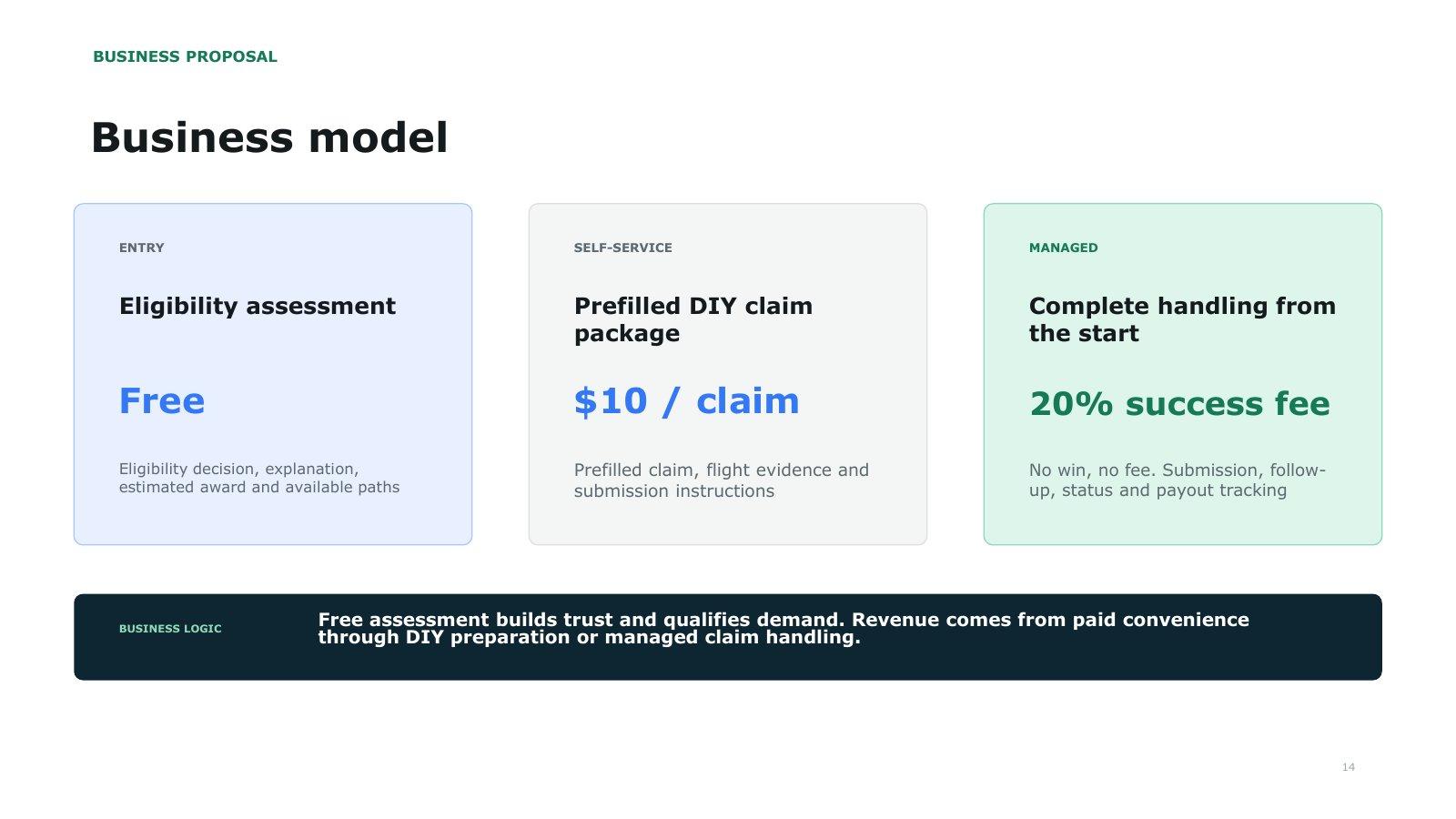
Business model: free, $10, 20% 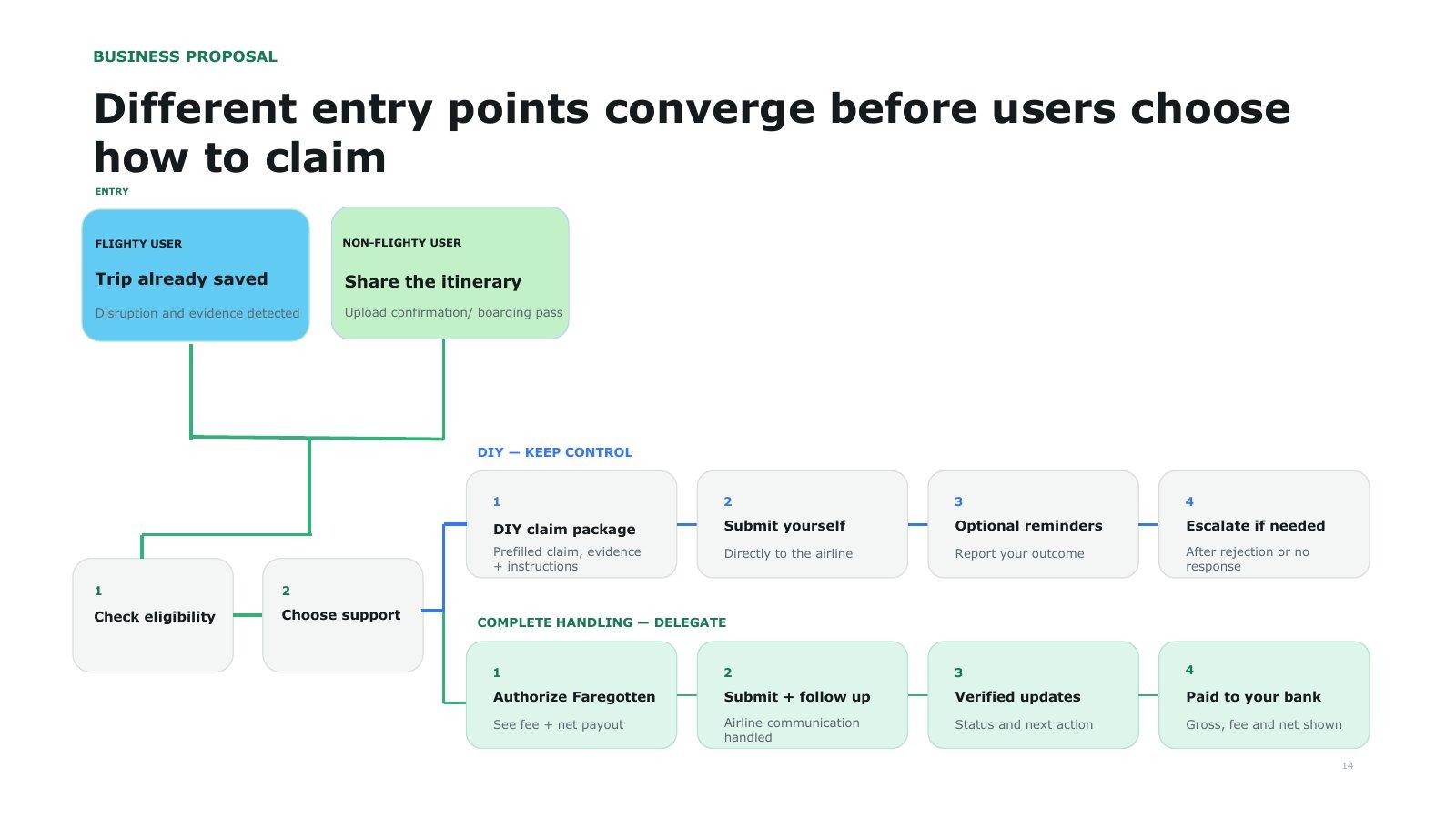
Two entry points, two service paths 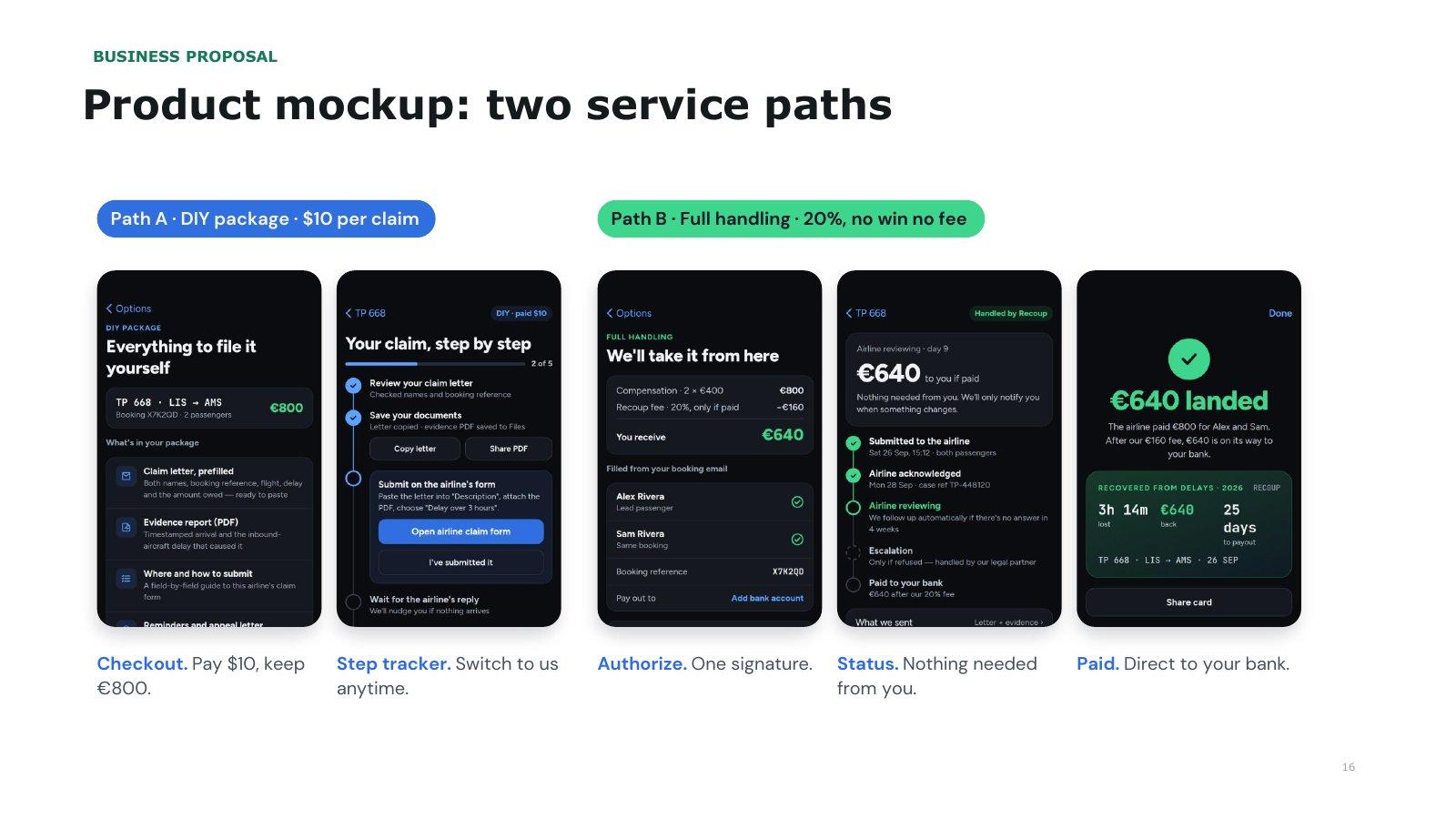
Mockups: DIY and full handling 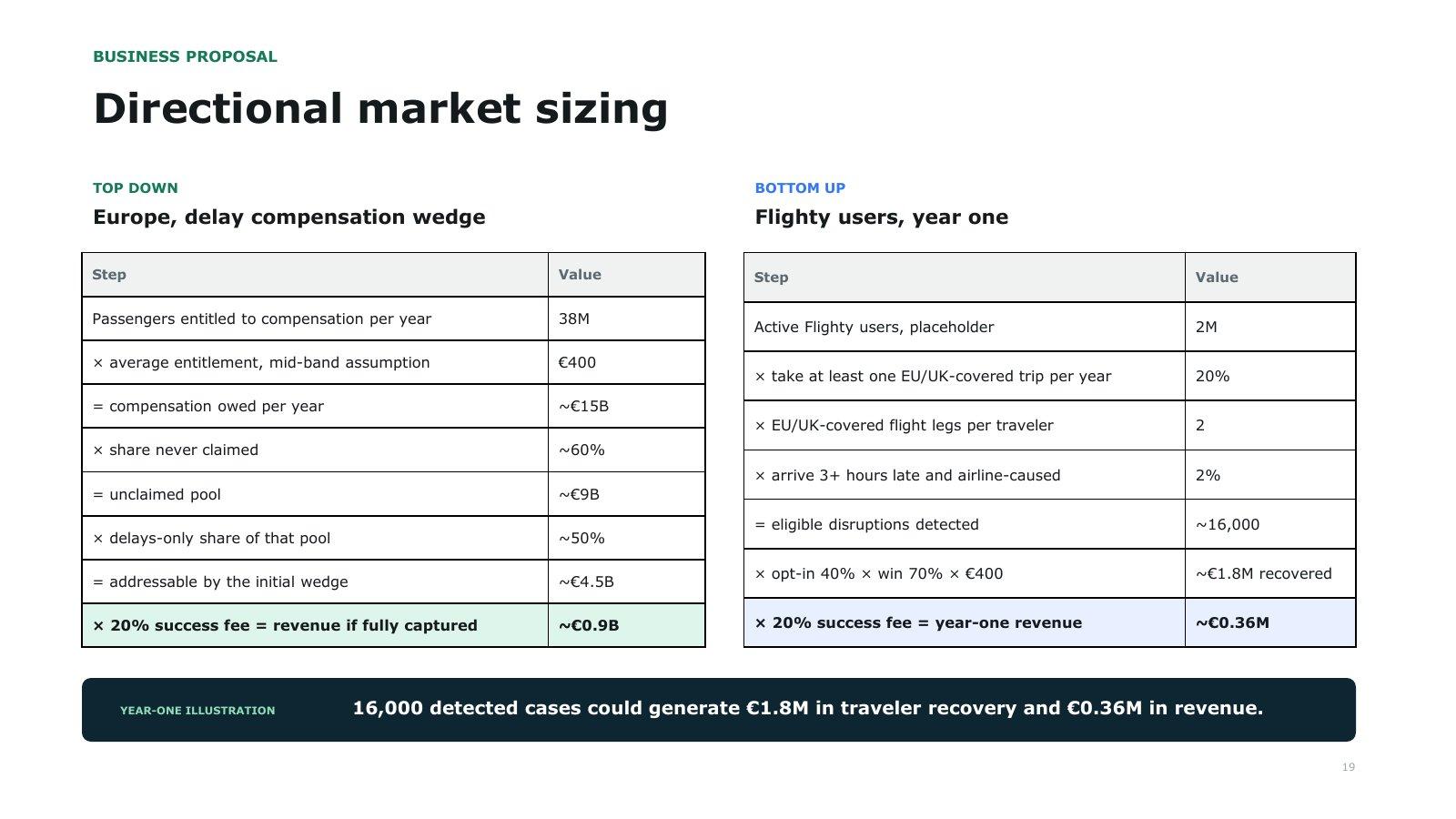
Market sizing, top-down and bottom-up 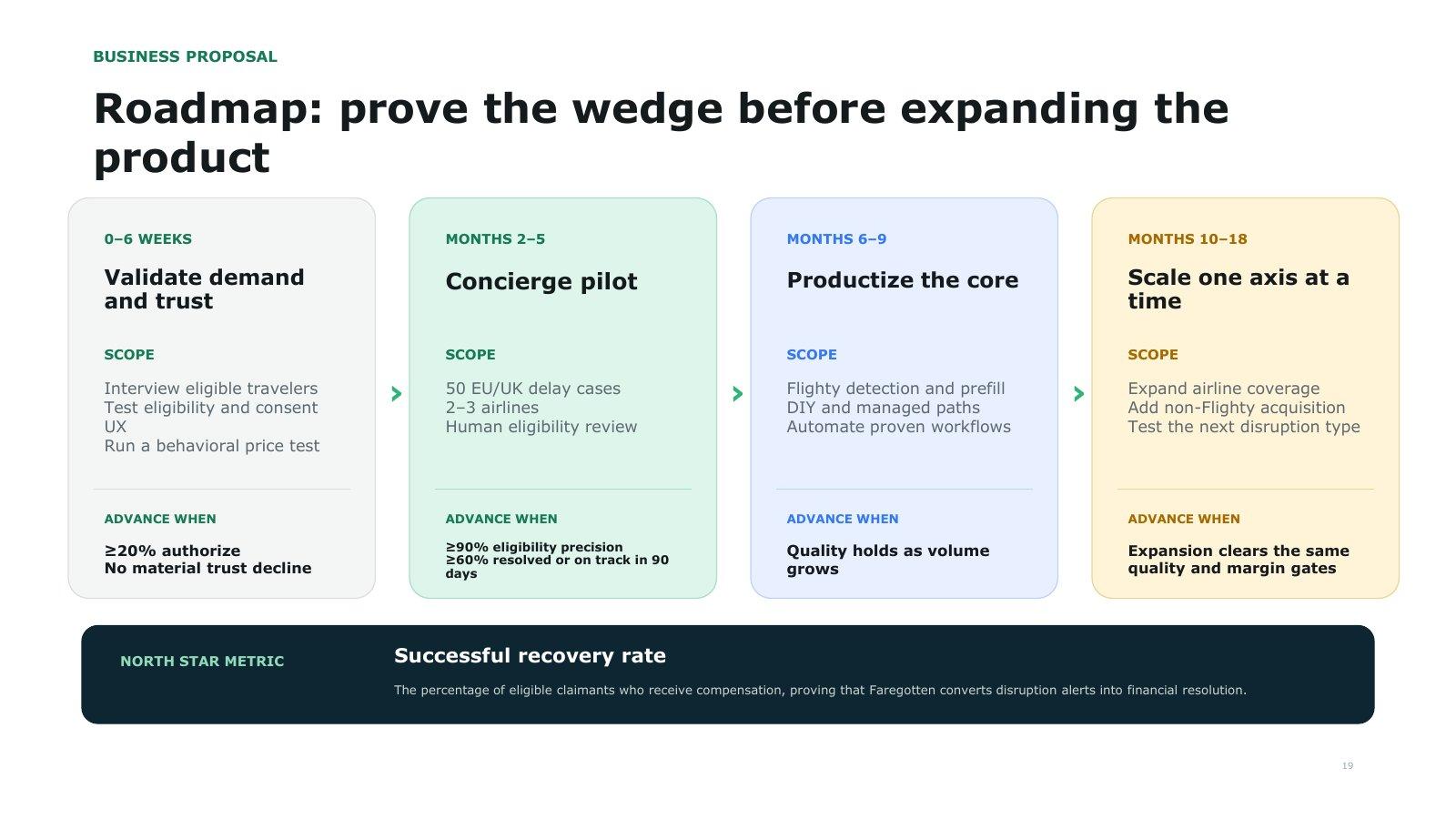
A gated roadmap to prove the wedge
Execution & collaboration
- Product teardown of Flighty’s core journey, trust loop, supporting loops and product psychology.
- Secondary research across 100+ competitor reviews, Reddit and BBB complaints; primary research with 5 interviews and 13 survey responses.
- Journey map of what travelers feel and do from disruption to rejection, and three customer segments by claim behavior.
- High-fidelity product mockups of the landing moment, the free eligibility check, and both the DIY and full-handling paths.
- Business model, competitive comparison, top-down and bottom-up market sizing, a gated 18-month roadmap, and a risk and mitigation plan.